Tales of the Tunnel Builders (Part 7): Overcoming Weak Geological Zones to Write the Miracle of Nui Vung Tunnel
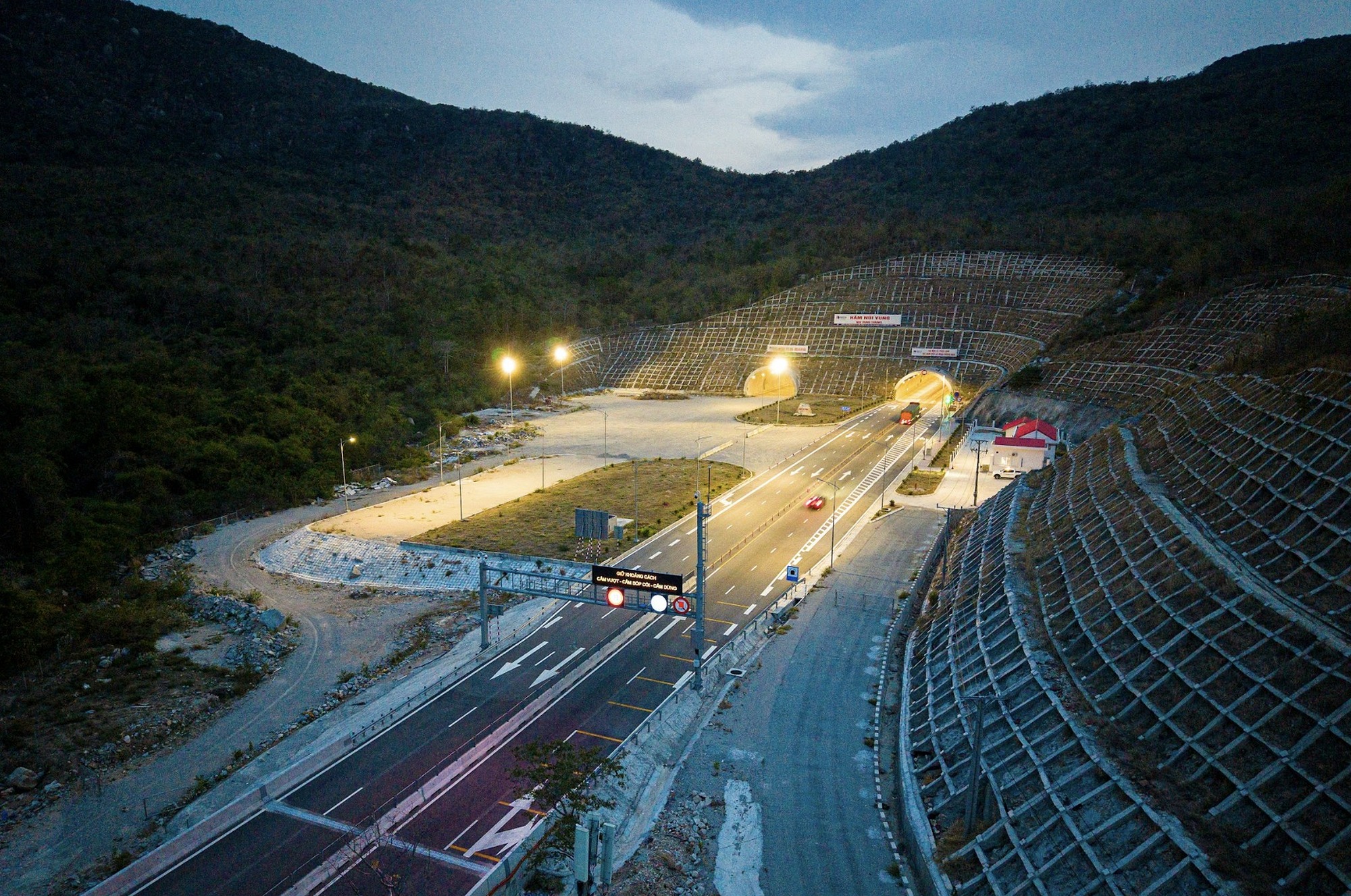
In the early days of June 2026, sitting in a car passing through Nui Vung Tunnel on the Cam Lam – Vinh Hao Expressway, watching the tunnel lights flash past the window like a slow-motion movie, my memories suddenly rushed back in full clarity. For tunnel builders like us, every cubic meter of excavated rock is not just soil and stone; it represents sweat and breathtaking battles of wits against the unpredictable shifts of geology.
The "Voice" of the Mountain...
In the tunneling community, we often pass down a saying: "Eating the food of the living world, doing the work of the underworld." This is not a complaint, but the harsh reality for those who face the darkness and unpredictable geological changes. Geological pressure is something no one can predict. There were nights when I was asleep, and just a single call from the construction site would make my whole body shiver with anxiety over a potential incident.
Having spent more than 20 years in the tunneling profession and worked across a series of key national projects such as Deo Ca, Cu Mong, and Hai Van... Nui Vung Tunnel remains the deepest "imprint" in my mind. I still remember vividly the afternoon of the 30th day of Tet (Lunar New Year's Eve) in 2022.
While families were bustling to prepare their year-end reunion dinners, I quietly entered Nui Vung Tunnel for a final inspection to arrange time off for the workers on the 1st day of Tet and to implement the state's blasting ban during the holiday. Arriving at the tunnel face, standing close to the tunnel wall to observe for about 30 minutes, I noticed small stones starting to loosen and fall.
That was the "voice" of the mountain. Intuition told me that the mountain was moving, and a catastrophic tunnel collapse could happen at any moment.
Without hesitation, I issued a "Red Alert." The surveying, technical, and machinery operating teams were fully mobilized right in the middle of the last afternoon of the lunar year. The batching plant fired up and mixed shotcrete (sprayed concrete) immediately.
The surveying results came back showing dangerous displacement at 2 out of 8 inspection points. Just 15 minutes later, concrete trucks rushed to the tunnel face. We sprayed concrete throughout New Year's Eve. To ensure safety, I ordered additional anchoring at the tunnel face and extra shotcrete applied to areas where the thickness was insufficient.
It wasn't until the total station showed stable indicators that I finally breathed a sigh of relief. That New Year's Eve, our year-end meal smelled strongly of concrete and rock dust, but it was the happiest meal because the tunnel was safe.
Fierce Yet Cautious
The geology at Nui Vung Tunnel was highly "anomalous." When we excavated nearly 300 meters in, we encountered a weak geological zone accompanied by a strong flow of groundwater. The shotcrete layer began to crack wide open, and monitoring stations continuously flashed warning signals at highly dangerous levels.
In that tense moment, practical combat experience taught us that we could not recklessly forge ahead at all costs. What was needed was a clear mind. We chose a "fierce yet cautious" approach—stopping to evaluate but absolutely never backing down.
The project management board immediately called an emergency meeting. Options were presented, debated quickly, and finalized under the principle of not being subjective or complacent.
Right after that, a series of technical solutions were deployed simultaneously: drilling drainage holes to relieve pressure; installing anchoring to reinforce the tunnel face; strengthening shotcrete; reducing the spacing of steel ribs to control deformation; pumping grouting to consolidate the geological area around the excavation boundary; and establishing a canopy anchoring system at the tunnel face.
Parallel to handling the situation on-site, we reported to the Group leaders, Project Management Board 85, Superintending Consultants... and mobilized a force of highly experienced engineers for support. Among them, the Group's most seasoned tunneling engineers were directly present at the scene to handle the crisis together.
Notably, the Group leadership also immediately invited Dr. Nguyen The Phung, a leading expert in tunneling, to join the "consultation" of the incident to find the optimal solution, ensuring the highest level of safety for the project.
I still clearly remember the image of Dr. Phung that day. Right after stepping off the plane, he was driven straight into the tunnel at 12:30 PM. Without taking time to eat or drink, he went straight down to the site, directly inspecting each displacement point. There were moments when teacher and students debated quite intensely over the consolidation grouting plan. We analyzed based on actual monitoring data to arrive at a consensus.
Leaving the site, we continued our meeting at the Management Board office. There, Dr. Nguyen The Phung and the technical team agreed to add reinforcement solutions for locations where steel ribs had been installed but deformation was still occurring.
Accordingly, sections without an invert arch were reinforced with vertical H200 steel supports, with their bases resting on reinforced concrete slabs. For locations with an invert arch, we proceeded to pour concrete for the invert and supported directly onto the structure's surface.
The meeting ended past 2:00 PM when the reinforcement solutions were finalized, and only then was the anxiety of a tunnel collapse relieved. Everyone's stomach was rumbling with hunger.
"One tree cannot make a hill..."
Throughout the construction process of Nui Vung Tunnel, overnight meetings at the Management Board gradually became a "specialty." Putting aside the hardships, we held onto a single goal: ensuring that the country's transport "artery" was safe and reached the finish line on schedule.
Later on, someone asked me: "Deo Ca already has so much experience, why did you still need to invite an expert?"
I just smiled and said: "One tree cannot make a hill, but three trees together can form a high mountain..." Successfully building a tunnel has never been a one-man game.
Especially when facing complex geology, collective strength is unleashed, particularly with the participation of experts. For us, each of their opinions was not just a piece of experience, but it contributed to building an extra layer of insurance for the project, and for the workers inside the tunnel themselves.
Tunnel geology always harbors unpredictable factors. And at Deo Ca, we choose to be receptive and open-minded. We do not trade the safety of the project, nor the lives of our workers, to gain "lessons of experience" for ourselves.
When the Southern face was stuck due to weak geology, we didn't just sit and wait. All machinery and manpower were redirected to accelerate excavation at the remaining three tunnel portals and speed up the concrete lining of the Northern tunnel. That is the flexibility, the "do it to the very end" culture of the Deo Ca people.
On July 3, 2023, Nui Vung Tunnel was successfully holed through right on schedule, to the astonishment of many. But to us, it was no surprise. Because it was the result of hundreds of sleepless nights, of decisions made during the most high-pressure moments, where every choice was tied to the safety of the entire project.
That success was not just a technical milestone, but a victory of will, determination, and the spirit of never backing down in the face of challenges.
Today, driving on this road, I can still clearly feel a surge of pride in my chest. Because I know those tunnel tubes were not just built with concrete and steel, but with the hearts of thousands of Deo Ca people who worked tirelessly deep within the mountain. So that vehicles traveling through the mountain can do so in peace, contributing to the development of Vietnam.
Written down by Thien Nam
(From the words of Engineer Ngo Huu Khoa - Director of the Management Board of package XL01, Khanh Hoa - Buon Ma Thuot Expressway Project Phase 1; former Director of the Nui Vung Tunnel Management Board).